
Workshop Information
Duration:
3 hours including 5-10 min breaks every hour
Details:
Date: April 22nd
Time: 2pm-5pm
Cost: $65 + GST
Location: Online
Includes:
- PDF of slides
- Digital Resources
- Reading List
- Access to resources and recordings for 3 months
- Certificate for PD hours
Brochure download:
Registration:
Related Procucts
-
 Low-Demand Connection Strategies – 14/12/2026$50.00
 -
 LEGO®-Based Therapy training for parents and practitioners – 01-02/12/26$950.00
 -
 Recognising Silent Bids for Connection – 14/08/2026$50.00
 -
 Autistic play cultures | 19/11/2026$100.00
 -
 Autistic play and learningPrice range: $0.00 through $25.00
 -
 Autistic play and learningPrice range: $0.00 through $25.00
This workshop explores autistic play through a neurodiversity-affirming lens. Instead of viewing autistic play as delayed or deficient, the session examines how sensory processing, pattern seeking, and interest-driven focus shape the way autistic children explore, learn, and connect with others. Drawing on research, autistic perspectives, and observational studies, participants will develop a deeper understanding of how autistic play works and why it matters. The workshop provides practical guidance on recognising autistic play styles and supporting play in ways that nurture wellbeing, autonomy, creativity, and meaningful social connection.

Workshop Details
Workshop aim
The aim of this workshop is to build a clear and respectful understanding of autistic play. Participants will explore how autistic cognition, sensory processing, and interest-based attention influence play behaviours. The session focuses on recognising autistic play as a meaningful developmental process and learning how adults can support play without disrupting autistic creativity, exploration, or connection.
In this workshop, you will learn:
- What play is and why it is an essential part of child development.
- How traditional developmental models describe play and where autistic play fits within or outside those models.
- How sensory processing influences the way autistic children explore objects, spaces, and activities.
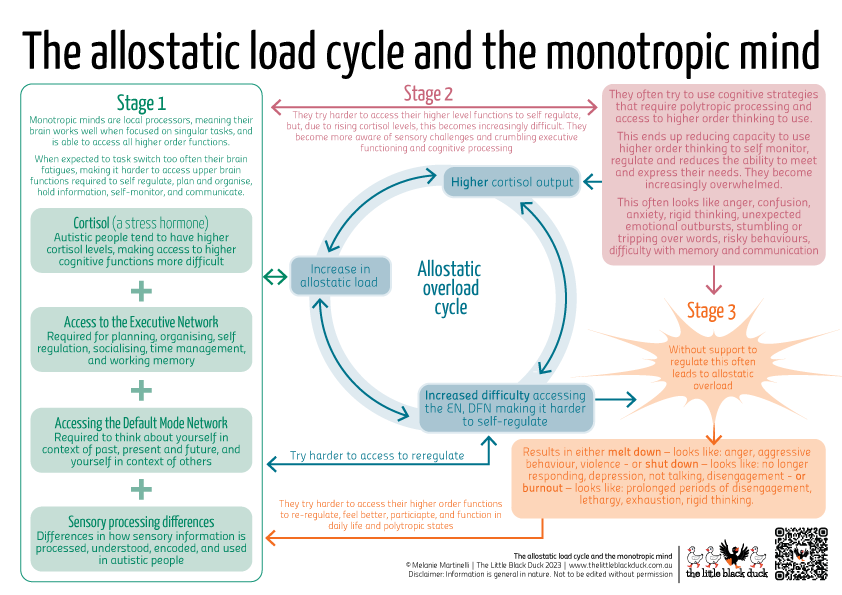
- How monotropism and deep interest influence autistic play and attention.
- Why solitary, parallel, and sensory play can be meaningful and developmentally appropriate for autistic children.
- What current research tells us about autistic play in playgrounds, classrooms, and natural environments.
- How autistic children form social connections through play, even when those connections look different from typical expectations.
- How repetitive play, pattern exploration, and object play support learning and emotional regulation.
- How environmental factors such as noise, crowding, and unpredictability can influence play behaviour.
- How adults can recognise and support autistic imaginative play without unintentionally interrupting it.
- How play can support wellbeing, communication, and emotional processing for autistic children.
Learning Outcomes
By the end of this workshop participants will:
- Understand how autistic cognition and sensory processing influence play behaviour.
- Be able to recognise a range of autistic play styles and understand their developmental value.
- Develop confidence in supporting play without interrupting autistic creativity and exploration.
- Understand how play can support emotional regulation, connection, and learning.
- Gain practical strategies for creating environments that support autistic play and wellbeing.

Workshop Attendance
Why Attend?
- You want to better understand autistic play from a strengths-based and neurodiversity-affirming perspective.
- You want practical insights that move beyond deficit-focused explanations of autistic behaviour.
- You want to learn how autistic cognition and sensory experiences influence play and exploration.
- You want to understand why some autistic children prefer solitary, sensory, or interest-focused play.
- You want to support autistic children without forcing them to play in ways that feel unnatural or stressful.
- You want to recognise when autistic play is supporting regulation, learning, and wellbeing.
- You want to learn how autistic children often connect socially through shared interests and structured activities.
- You want to improve how play is supported in classrooms, therapy settings, or community spaces.
- You want to understand the role of environment and sensory safety in supporting successful play experiences.
- You want to learn how play-based approaches can support emotional wellbeing and development.
Who Should Attend
This workshop is suitable for anyone who supports or works alongside autistic children.
It may be particularly helpful for:
- Autistic adults who would like to explore autistic play and development from a neurodiversity-affirming perspective.
- Parents and caregivers who want to better understand how their autistic child plays and learns.
- Early childhood educators and teachers who support autistic students in classrooms and playgrounds.
- Allied health professionals who use play within therapy or developmental supports.
- Disability support workers who want to better understand how autistic children explore and engage with the world.
- Community organisations that support neurodivergent children and families.
Participants do not need prior knowledge of autism research. The workshop explains concepts clearly and focuses on practical understanding that can be applied in everyday settings.